1 2 3 4 Player Games - Offline
- 4.6
- Rating
- 100.00M
- Installs
- Free
- Price

 Analysis by App-foxy
I have a soft spot for games that need almost no preparation. 1 2 3 4 Player Games - Offline is built around that exact idea: one device, a group of people, and a collection of quick arcade challenges that can turn a quiet wait or casual gathering into a small competition. My overall view is positive, but with an important qualification: this is much better as a shared party game than as a deep solo arcade experience.
That distinction matters before you install it. The appeal is not a long campaign, a carefully developed story, or a complex progression system. The appeal is handing a phone or tablet to two, three, or four people and getting everyone playing quickly. When the situation is right, that simplicity is the reason it works. When you are alone and looking for a substantial game, the same simplicity can feel limiting.
Why the quick multiplayer format works so well
The game comes from JindoBlu and sits firmly in the arcade category. Its central design choice is easy to understand: several players share one screen and compete in short games. That makes it especially useful when a group wants something interactive but does not want to create accounts, coordinate separate devices, or spend time learning a complicated ruleset.
You May Also Like

 Pandora - Music & Podcasts
Pandora’s Music Is Easy to Start, but Harder to Recover
Pandora’s strength is its low-effort path from a seed to a station. Its weak spot is how much confidence it asks you to place in connection, setup, and quiet recovery.

 8 Ball Pool
 Is Built on Rivalries, Rematches, and Routine
A close look at the rivalries, rematches, shared routines, and unanswered safety questions that turn a quick pool match into a persistent mobile community.

 Samsung Music
’s Quiet Strength Is Playing What You Already Own
Its reach comes less from spectacle than from dependable access to a personal library. That simplicity is both the app’s strongest retention engine and its ceiling.

 AccuWeather: Weather Radar
AccuWeather Review: A Quick, Clear Forecast for Everyday Decisions
For everyday plans, the best forecast is the one you can understand quickly. AccuWeather makes rain timing, radar, and local conditions easy to act on, with a few trade-offs.

 Hill Climb Racing
Why Hill Climb Racing Still Turns Crashes Into One More Run
A tiny car, a bumpy hill and one more upgrade: Hill Climb Racing keeps resurfacing because its simple chaos makes every near-miss feel personal.

 AliExpress - Shopping App
AliExpress Makes Global Shopping Feel Personal, but Shoppers Bear the Risk
AliExpress turns a global marketplace into a pocket-sized discovery engine. Its reach is useful, its shopping loop compelling, and its trade-offs easy to miss.
More From Our News Desk
View All News


In my experience, the strongest part is the low barrier to entry. You can explain the basic idea in a few seconds, pass the device around, and let each person discover the challenge through play. This is a better fit for spontaneous sessions than many conventional multiplayer games, where everyone first has to download the same title, connect to a network, and understand a tutorial.
The shared-screen format also changes the social mood. Players are watching one another, reacting to mistakes, and celebrating close wins instead of staring at separate displays. That makes even a very small challenge feel more lively. The game is not trying to replace a full console party title; it is trying to make a phone useful as a compact source of group entertainment, and it understands that role well.
It is also free to download, which removes the biggest practical obstacle for a casual group. The age classification is Everyone, so it is suitable for family settings and mixed-age gatherings. I would still recommend checking the screen size before starting: a small phone can make four-player sessions feel crowded, while a larger device gives each person a more comfortable area to watch and react.
A good choice for short, unplanned sessions
The best everyday use case is not a carefully scheduled game night. Imagine waiting with friends before a meal, sitting together during a trip, or having a few minutes to fill while everyone is in the same room. Instead of asking each person to find a separate activity, one player opens the game and the group can begin. The short-round structure helps because nobody has to commit to a long session.
That format is particularly effective when attention is divided. People can join the fun without needing to remember a complicated plot or maintain a long-term character build. If someone loses early, the next round offers an immediate chance to recover. If another person needs to step away, the group has not lost hours of progress.
There is a useful social rhythm here: play, laugh, argue about a close result, then start again. The game encourages that rhythm more naturally than a solo arcade title. I found that the entertainment often comes as much from watching other people handle pressure as from the challenge itself.
What makes the multiplayer design more valuable than it first appears
A less obvious strength is how the shared device changes the importance of fairness. In an online game, connection quality, account differences, and familiarity with the controls can affect the experience. Here, everyone is physically present and using the same device. That does not make every contest perfectly balanced, but it gives the group a common reference point and makes disagreements easier to resolve.
Another practical advantage is that the game does not require the group to agree on one particular genre first. One person may enjoy reflex challenges, another may prefer something more relaxed, and a third may simply want to watch before joining. A collection of brief arcade activities gives the group more opportunities to find a shared mood than a single-purpose game would.
I also like the way the format supports informal tournaments. You can decide that each round is worth a point, keep a simple score in conversation, and stop whenever the group is ready. This is not a formal competition system that demands long-term commitment; it is a flexible framework that works well when the players create their own rules.
That flexibility is one of the reasons the game has attracted a large audience. It has passed 50 million installs and holds an average rating of 4.6, which suggests that the basic concept connects with many players. Those figures do not make it automatically right for everyone, but they match my impression that its strongest qualities are immediate accessibility and group appeal.
Controls, pacing, and the shared-screen trade-off
The controls are designed for quick understanding rather than depth. That is exactly what a party game needs, but it creates a trade-off. Players who enjoy mastering precise systems, studying advanced tactics, or building a specialized play style may find the individual challenges too light. The game rewards quick reactions and willingness to participate more than extended practice.
The device itself becomes part of the experience. With two players, the arrangement is usually easier to follow because each person has more visual space and a clearer sense of where to focus. With four, the energy can be higher, but the screen can also become busy. I would use a tablet or the largest available phone when the group is full, especially if everyone needs to react at the same time.
This is also a game where social confidence matters. A shy player may need a round or two before feeling comfortable competing in front of everyone. I have found that rotating the device and treating the first attempt as practice helps. The short format is useful here because a poor opening round does not define the whole session.
The meaningful limitation: variety does not equal depth
The main weakness is the same feature that makes the game approachable. A collection of quick arcade games can provide variety, but individual activities may not hold attention for a long time if you play alone. Once the novelty of a challenge fades, there may be less reason to keep returning than there would be in a game built around progression, exploration, or a more demanding competitive system.
This is not a flaw that can be solved simply by adding more content. The game’s identity depends on speed and simplicity. More layers could make it less suitable for spontaneous group play. Still, it is important to set realistic expectations: this is a pocket-sized party collection, not a replacement for a full multiplayer platform with deep matchmaking or a substantial single-player campaign.
There can also be a little friction when several people share one device. Players must stay close enough to see the screen, and the person holding it may have a slightly different physical relationship with the controls. In a noisy room, instructions or results can be missed. These are not software problems so much as consequences of the format, but they affect whether the game feels comfortable in a particular setting.
Another limitation is replay motivation. A group can create its own scoring rules, rematches, and mini-tournaments, which helps considerably. However, if nobody in the group enjoys friendly competition, the quick challenges may feel disposable. The game works best when players are willing to react, tease one another, and try again rather than treating every round as a serious test.
Who should install it, and who should skip it?
I would recommend it to families, friends sharing a room, and anyone who wants a simple alternative to passing around a single-player game. It is particularly well suited to people who want multiplayer entertainment without separate phones or a complicated setup. Younger players can understand the premise quickly, while adults can enjoy the competitive atmosphere without needing to invest in a long session.
It is also a good backup game for travel and waiting rooms, provided the group is comfortable sharing one screen. The offline-oriented concept is valuable when the goal is local play rather than online coordination. For a casual gathering, that can be more convenient than trying to connect several devices to the same match.
I would be more cautious about recommending it to someone who mainly plays alone. If your ideal arcade game involves chasing sophisticated high scores, unlocking a broad progression path, or refining one mechanic for weeks, this may feel too shallow. A dedicated single-player arcade title would probably serve you better. Likewise, players who dislike physical proximity or shared controls should choose a conventional online multiplayer game instead.
It is worth remembering that the game is free, but “free” does not mean every player will find it equally valuable. The real question is whether you regularly have other people nearby. If the answer is yes, the download makes sense because the game can be opened whenever the opportunity appears. If you almost always play alone, its central advantage is harder to use.
Practical advice for getting better sessions
For the smoothest experience, decide the session format before starting. A simple rule such as “winner stays on” can keep the pace moving, while a fixed number of rounds gives everyone a fair chance. This prevents the most confident player from dominating the device and gives quieter participants a clear opportunity to join.
When playing with four people, use a stable surface rather than holding the device in one hand. That small change makes the screen easier for everyone to see and reduces accidental movement. It also helps to place the device where the group can gather around it without blocking one another’s view.
I would begin with a short trial rather than promising a long tournament. Let everyone play a few rounds, then see which challenges produce the best reactions. This avoids forcing the group through activities that do not suit its mood. If the players are laughing and asking for rematches, continue; if attention drops, the game has already done its job as a quick diversion.
For families, alternating teams can be more enjoyable than putting every player against every other player. A child who is still learning can receive help from an older teammate, while the adults still have a reason to stay involved. For friends, keeping a running score can add tension, but I would avoid making the result too serious. The game is at its best when the competition remains light.
The current version is 2.25.2 and it runs on Android 6.0 or later. That makes it accessible to people using older compatible devices, although the practical comfort of a group session still depends on the screen and hardware in hand. Before a planned gathering, I would install it in advance and test the device placement rather than waiting until everyone is ready to play.
How it compares with the usual alternatives
Compared with online multiplayer games, this one wins on immediacy. There is no need to make sure several people are online at the same time or to explain a large ruleset before the first match. The cost of that convenience is reduced depth and less room for players who want a persistent competitive identity.
Compared with board games, it is faster to set up and easier to carry, but it does not offer the same tactile feeling or strategic development. A board game may create a richer evening for a group willing to sit down and learn rules. This app is better when the group wants entertainment in the gaps between other activities.
Compared with passing around a single-player arcade game, it clearly has the advantage of making everyone part of the action. The downside is that the shared screen can feel crowded and the challenges may not provide the same focused practice. In other words, it is a social tool first and a personal skill game second.
That comparison explains my final recommendation. Do not install it expecting a deep arcade journey. Install it because you want a reliable way to turn one mobile device into a quick group activity. The distinction sounds simple, but it prevents the most common disappointment.
My final verdict
JindoBlu has made a focused game that understands its audience. The concept is uncomplicated, but the execution is useful: several people can gather around one device and start competing without a long setup. The Everyone rating, free access, and broad device compatibility make it easy to suggest for families and casual groups.
My criticism is equally clear. Solo players may run out of reasons to return, and players seeking deep mechanics should look elsewhere. The shared-screen format also works best when the group has enough space and patience to take turns. Those limitations are real, but they do not undermine the game’s intended purpose.
My recommendation is simple: choose it when the people around you are more important than the device itself. For an impromptu match between friends, a family break, or a few spare minutes with several players nearby, it is a convenient and genuinely enjoyable arcade option. For a serious solo gaming habit, I would pick a more focused alternative. Used in the right setting, though, this is the kind of small game that can make an ordinary moment noticeably more fun.
FAQs for 1 2 3 4 Player Games - Offline
01What is 1 2 3 4 Player Games - Offline?
1 2 3 4 Player Games - Offline is a versatile app offering a collection of mini-games that can be played solo or with friends. It features a variety of simple yet entertaining games designed to provide quick fun during gatherings or downtime, without the need for an internet connection.
02Do I need an internet connection to play these games?
No, 1 2 3 4 Player Games - Offline is designed to be played without an internet connection. This makes it perfect for use in places with limited connectivity or when you want to save on data usage while still enjoying multiplayer gaming.
03How many players can play these games simultaneously?
The app supports up to four players, allowing for a range of multiplayer options. You can choose to play solo, or with 2, 3, or 4 players, making it ideal for small group gatherings or family fun. Each game is designed to be easily played on a single device.
04What types of games are included in the app?
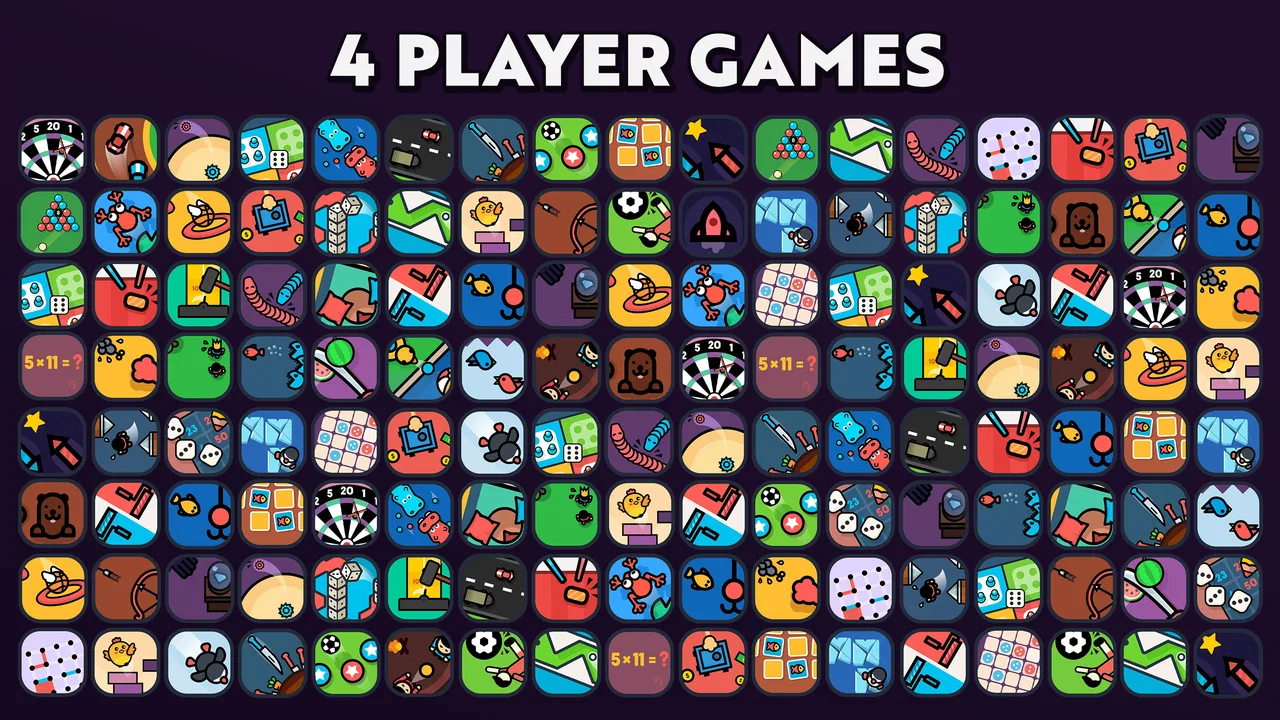
The app includes a variety of mini-games ranging from action and strategy to puzzles and sports. Each game is simple and intuitive, ensuring that players of all ages and skill levels can enjoy them. The selection is designed to keep everyone entertained for hours.
05Is the app suitable for children?
Yes, 1 2 3 4 Player Games - Offline is family-friendly and suitable for children. The games are easy to understand and play, with content appropriate for all ages. Parents can feel comfortable letting their kids play while joining in the fun themselves.
Pros
- Wide variety of games for different tastes.
- No internet connection required to play.
- Supports up to four players on a single device.
- Simple and intuitive controls for all ages.
- Regular updates with new games added.
Cons
- Limited graphics compared to online games.
- Some games may feel repetitive over time.
- Ads can be intrusive during gameplay.
- No online multiplayer mode available.
- Occasional bugs in certain games.

1 2 3 4 Player Games - Offline
Gallery